
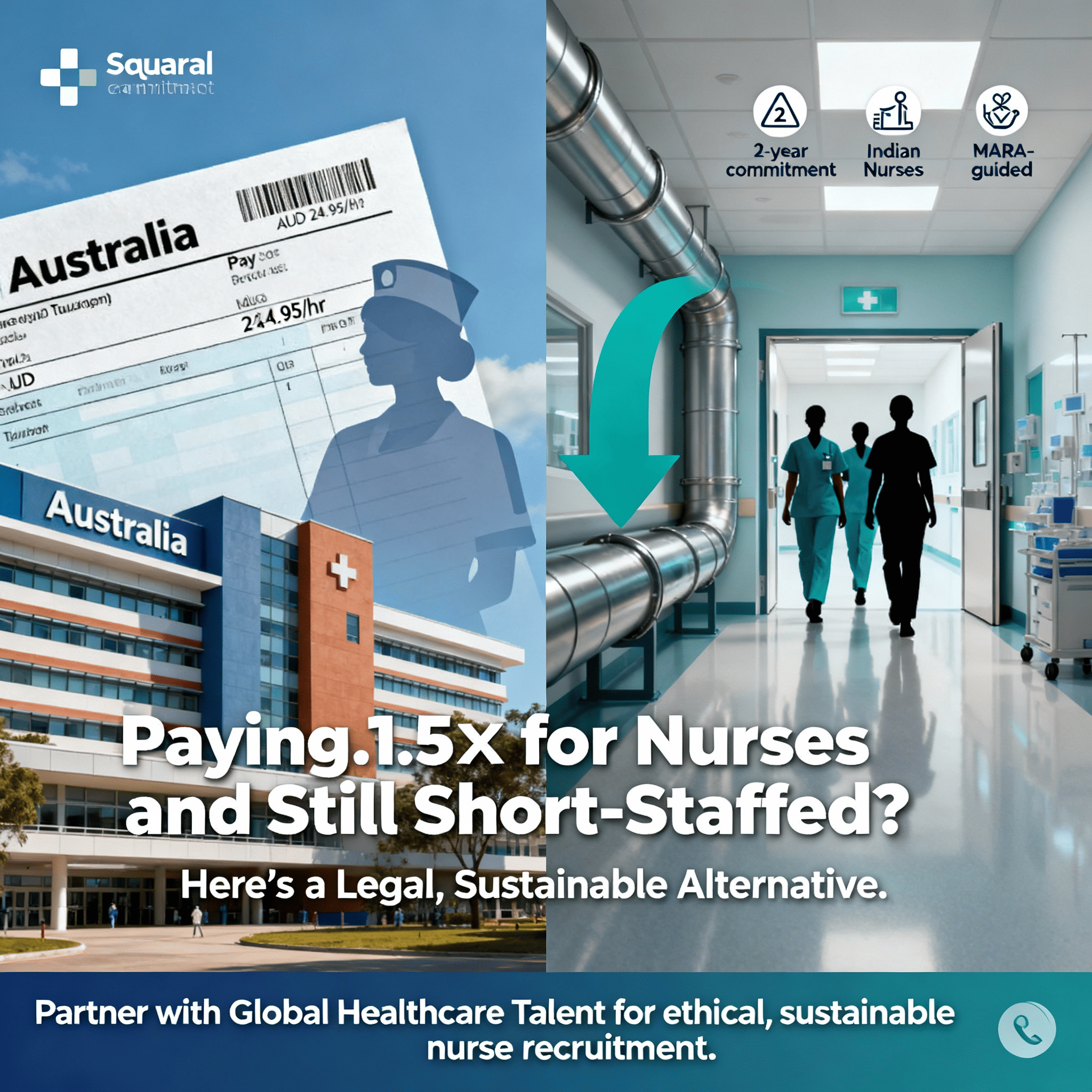
Across Australia, nurse recruitment has become a pain point for hospitals and care facilities. Despite record spending—often upwards of 1.5 times the national minimum wage of AUD 24.95 per hour—providers remain challenged to retain nurses for much beyond the initial months, especially in regional and rural areas. Costly incentives, sign-on bonuses, and relocation allowances are the norm, but long-term retention stays weak, burnout is rising, and the financial burden is becoming unsustainable.
The High-Wage, Low-Retention Paradox in Nurse Recruitment
In theory, paying nurses more should improve attraction and retention. In practice, nurse recruitment teams in Australia report the opposite:
Rural and regional facilities are forced to offer elevated hourly rates, relocation packages, and frequent bonuses just to hire for hard-to-fill roles.
Once nurses arrive, burnout, isolation, heavy workload, and personal factors often lead them to leave within 1–2 years—sometimes much sooner—even with higher pay.
Employers are stuck in a loop: premium rates, constant onboarding, agency dependence, and no stable workforce.
This creates a damaging mix: salary outflow, disrupted care continuity, stressed HR teams, ongoing compliance risks, and rising recruitment costs.
Financial & Operational Pressure on Hospitals
This staffing model hits care organisations in three critical ways:
Cost Blow-Outs: Paying 1.5x or more above minimum wage, added incentives, and bonuses push nurse labour costs to the top of operational expenses—without any guarantee of nurse retention.
Disrupted Care & Quality Risk: Relentless turnover means repeated orientation, loss of clinical continuity, and gaps in patient care and leadership.
HR Burnout & Compliance Risk: Recruitment specialists are forced into constant hiring cycles, visa tracking, Fair Work compliance checks, and firefighting—rather than strategic workforce development.
Australian government projections highlight a shortfall of tens of thousands of nurses by 2025–2030, heavily impacting rural and aged-care settings. More money alone, without reform, is not the answer to the nurse recruitment and retention crisis.
Global Healthcare Talent: A Different Approach to Nurse Recruitment
Global Healthcare Talent (GHT), a specialised division with 25+ years’ experience and over 100,000 placed candidates globally, is now recruiting nurses and healthcare workers specifically for Australian employers. GHT’s model targets three employer needs:
Cost Stability: Lawful minimum wage and predictable contracts
Predictable Retention: Structured 2-year commitments—not endless churn
Compliance & Visa Integrity: MARA-guided processes with no shortcuts
Partnering with Experienced Indian Nurses at Lawful Minimum Wage
India offers one of the largest talent pools of English-speaking, internationally competent nurses, with 5–15 years’ clinical experience and a strong reputation for adaptability and resilience. Right now, GHT is recruiting nurses willing to work in Australia at the legal minimum (AUD 24.95/hr), on compliant 2-year contracts. Employers benefit from:
Significantly lower costs versus rural premiums or agency rates
Nurses pre-committed for 2 years—reducing churn and boosting stability
High-experience candidates, not just recent graduates
This is not about underpaying, but replacing “crisis rates” with sustainable, legal models—giving nurses a life-changing career lift, while helping employers break out of the high-pay, low-retention trap.
Fully Compliant Recruitment, Visa & Placement
To keep Australian employers protected, GHT collaborates with registered MARA migration professionals for seamless nurse recruitment. Typical pathways include:
Temporary Skills-Based Work Visa (482/Skilled in Demand): Employer nominates the nursing role; candidate matches skill, registration, and English; visa ties to contract
Transition to PR (Employer Sponsored or Skilled): Possible after a successful partnership period
GHT handles pre-screening, AHPRA registration assistance, documentation, and visa compliance—so you get talent ready for the floor, not paperwork headaches.
Why Partnering Matters for Australian Nurse Recruitment
For hospital owners, care home managers, and HR heads, a GHT tie-up means:
Lower recruitment costs—return from emergency rates to legal baseline
Stronger retention—nurses ready for two-year commitment, not “try and leave”
Better care delivery—stable teams with continuity and clinical leadership
Reduced agency dependence—HR focus shifts from urgent hiring to talent strategy
Escape high-pay, low-retention chaos and build a workforce for the future—powered by GHT and the Indian nurse talent pool.